

In Islam, divorce (Talaq) is permitted as a last resort when a marriage cannot continue. Under the Hanafi school of jurisprudence which governs Pakistan's family law, divorce takes five main forms: Talaq-e-Tafweez (delegated to the wife), Talaq-e-Mubarat (mutual), Talaq-e-Hasan and Talaq-e-Ahsan (gradual), Talaq-e-Bain (irrevocable), and Talaq-e-Mughallazah (triple, also called Talaq-e-Bidat). Under the Pakistani Muslim Family Laws Ordinance 1961, every Talaq must be communicated to the local Arbitration Council, and a 90 day iddat (waiting period) must elapse before the divorce becomes final.
In our 30+ years of practice, we have advised on all forms of Talaq across Hanafi, Shafi'i, and other madhahib. In our experience, the most common client misunderstanding concerns the revocability of Talaq-e-Ahsan versus the irrevocability of triple-pronouncement Talaq-e-Mughallazah under Pakistani personal law.
Divorce in Islam, known as “Talaq,” encompasses various forms and procedures that reflect the religion’s emphasis on justice, mutual consent, and the welfare of both parties. Understanding these different types of divorce in Islam can help demystify the process and highlight the roles and responsibilities involved. In this comprehensive guide, we will explore the five primary forms of divorce in Islam: Talaq-e-Tafweez, Talaq-e-Mubarat, Talaq-e-Hasan (Talaq-e-Ahsan), Talaq-e-Bain, and Talaq-e-Mughallazah (Talaq-e-Bidat).
Types of Divorce in Islam at a Glance
| Type of Divorce | Initiated By | Revocable? | Iddat Required | Pakistani Legal Status |
|---|---|---|---|---|
| Talaq-e-Tafweez | Wife (right delegated by husband in Nikah Nama) | Yes, during iddat | 90 days from notice | Valid under Section 8 of MFLO 1961 |
| Talaq-e-Mubarat | Both spouses by mutual agreement | Not by design (final agreement) | 90 days | Valid under MFLO 1961 |
| Talaq-e-Ahsan (best form) | Husband (one pronouncement) | Yes, during iddat | 90 days | Valid and preferred |
| Talaq-e-Hasan (good form) | Husband (three pronouncements over three Tuhrs) | Yes, after 1st and 2nd; no after 3rd | Yes between pronouncements | Valid |
| Talaq-e-Bain | Husband (irrevocable form) | No (Halala required to remarry) | 90 days | Valid |
| Talaq-e-Mughallazah / Bidat | Husband (three pronouncements in one sitting) | No | 90 days | Valid in Pakistan; banned in several Muslim countries |
| Khula | Wife (judicial dissolution) | No once decreed by Family Court | Yes (post-decree) | Valid under Dissolution of Muslim Marriages Act 1939 |
Khula is included for completeness since users searching "types of divorce in islam" frequently also want to know female-initiated options. The Khula route is technically a court-decreed dissolution rather than a Talaq, but it is the corresponding mechanism for wives under Hanafi law and Pakistani family law. For a complete walk-through, see our Khula Divorce guide.
Introduction With the Types of Divorce in Islam
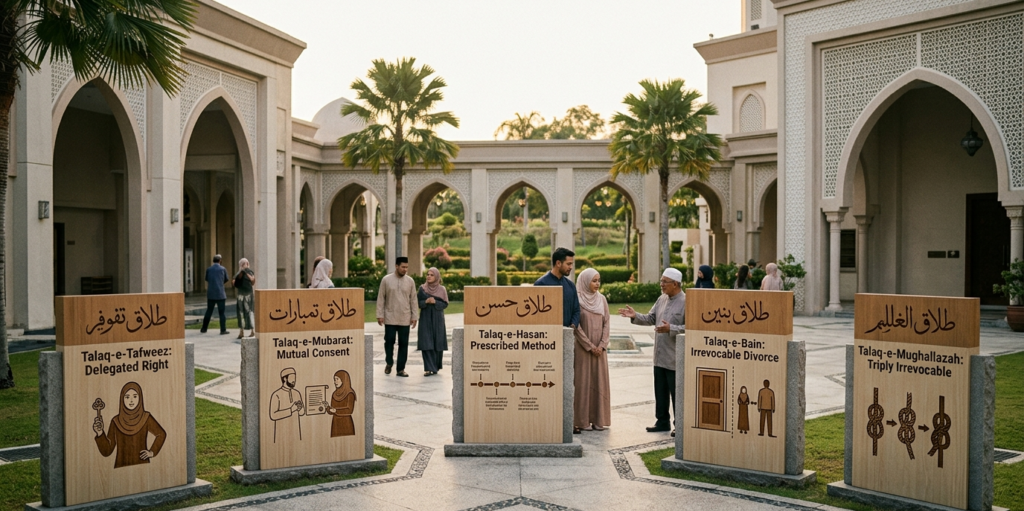
In Islam, divorce is viewed as a last resort when a marriage cannot continue due to irreconcilable differences. The process is designed to be fair and considerate, ensuring that both parties have the opportunity to resolve their issues before making their final decision. Different types of divorce cater to various situations and needs, each with its own procedures and implications.
Talaq-e-Tafweez (Delegated Divorce)
Initiation: Talaq-e-Tafweez, also known as Talaq-e-Tafwid, involves the husband delegating the authority to pronounce divorce to his wife or a third party. This delegation must be specified in the marriage contract or through a separate agreement.
Delegation of Power: In this form of divorce, the husband grants the right to initiate divorce to the wife or another designated person. This right can be exercised under specific conditions outlined in the agreement, ensuring clarity and mutual consent.
Agreement: The conditions and details of Talaq-e-Tafweez are typically specified in the marriage contract or a written agreement, which both parties must be aware of and agreed upon. This written form ensures transparency and helps avoid misunderstandings.
- It is now settled by the Supreme Court of Pakistan that where the husband has delegated the right of divorce to the wife under Section 8 of the Muslim Family Laws Ordinance, 1961, the wife, upon exercising Talaq-e-Tafweez, stands in the shoes of the husband for purposes of Section 7, and therefore the delegated talaq does not become effective immediately; rather, it remains revocable and only becomes effective after expiry of 90 days from service of notice upon the Chairman, unless earlier revoked.
Talaq-e-Mubarat (Mutual Divorce)
Mutual Agreement: Talaq-e-Mubarat requires the mutual consent of both the husband and wife to end the marriage. Unlike other types of divorce, this type emphasizes cooperation and mutual agreement.
Negotiations: The process often involves negotiations between the spouses regarding financial matters, custody of children, and other relevant issues. These negotiations aim to ensure a fair and amicable resolution for both parties.
Amicable Resolution: Talaq-e-Mubarat is considered a more amicable way of ending a marriage. Both parties reach a mutual understanding, making the process less contentious and more respectful.
Talaq-e-Hasan (Gradual Divorce)
Gradual Pronouncement: Talaq-e-Hasan, also known as Talaq-e-Ahsan, involves a gradual pronouncement of divorce over an extended period. This method is designed to provide time for reflection and reconciliation.
- Ahsan Talaq (The Best Form) Ahsan Talaq is considered the most proper and preferred method of divorce under Islamic law. In this form, the husband gives only one clear pronouncement of Talaq during the wife’s period of purity (Tuhr), when no marital relations have taken place in that cycle. After the pronouncement, the wife observes the mandatory waiting period called Iddat. During this time, the husband has the right to revoke the divorce and resume the marriage without a new Nikah, provided reconciliation is intended. If no revocation occurs during Iddat, the divorce becomes final. This method reflects patience, dignity, and an opportunity for reunion.
- Hasan Talaq (The Good Form) Hasan Talaq is another valid form of divorce recognized in Islamic jurisprudence, though it is less preferred than Ahsan Talaq. Under this method, the husband pronounces one Talaq during a period of purity, then waits until the next Tuhr to make the second pronouncement, and again waits for the third Tuhr for the final pronouncement. No marital relations should occur during these intervals. The divorce remains revocable after the first and second pronouncements, allowing the couple time to reconcile. However, once the third Talaq is pronounced, the divorce becomes irrevocable, and the marriage ends permanently under Shariah principles.
Waiting Period (Iddah): There is an obligatory waiting period (iddah) after each pronouncement, typically spanning three menstrual cycles. During this time, reconciliation efforts are encouraged, allowing both parties to reconsider their decision.
Reconciliation: The emphasis on reconciliation is a key feature of Talaq-e-Hasan. If the couple reconcile during the waiting period, the divorce does not proceed final, highlighting Islam’s preference for maintaining the marital bond whenever possible.
Talaq Raj‘i (revocable Divorce) "verdict required"
1) Under Hanafi School
If the husband gives one clear pronouncement of Talaq (for example: “I divorce you”), then:
- It counts as one (1) revocable divorce (Talaq-e-Raj‘i)
- The marriage is not immediately and permanently terminated
- During the iddah period (generally three menstrual cycles, or approximately three months if applicable), the husband may revoke the divorce (ruju‘)
- If the iddah ends without revocation:
- The marriage ends
- But the parties may remarry each other through a new nikah
- It does not count as three divorces
- If only one pronouncement is made, it is treated as one Talaq only
2) Under Shafi‘i School
Under the Shafi‘i school, if the husband gives one clear pronouncement of Talaq, then:
- It counts as one (1) revocable divorce (Talaq Raj‘i)
- The husband may take the wife back during iddah
- If iddah expires without reconciliation:
- The marriage ends
- But they may remarry with a fresh nikah.
Talaq-e-Bain (Irrevocable Divorce)
Irrevocable Nature: Talaq-e-Bain is a final and irrevocable form of divorce. Once pronounced three times, the marriage is terminated, and the couple cannot remarry unless specific conditions for "Halala" are met according to the Hanafi Law.
Halala Requirement: After Talaq-e-Bain, if the divorced woman wishes to remarry her former husband, she must first marry another man without any plan or intention of subsequent divorce, the second marriage must be consummated, and only if that second husband independently divorces her can she remarry her first husband after completing the iddat period as prescribed under Shariah. This process, known as Halala, is intended to discourage hasty divorces and to ensure the seriousness of the decision.
Serious Consequences: Given its finality, Talaq-e-Bain is considered a serious step. Both parties are encouraged to exhaust all possibilities of reconciliation before resorting to this form of divorce.
Talaq-e-Mughallazah (Triple Divorce)
Triple Pronouncement: Talaq-e-Mughallazah, also known as Talaq-e-Bidat, involves the husband pronouncing “talaq” three times in one sitting. This instant divorce is irrevocable and immediately terminates the marriage under Hanafi school of law.
Instant and Irrevocable: This form of divorce is considered the most severe and is often discouraged due to its immediate and irrevocable nature. The triple pronouncement leaves no room for reconciliation, reflecting a drastic and final decision.
Legal and Religious Controversies: Talaq-e-Mughallazah has been the subject of significant debate and legal reform in many Muslim-majority countries. Some jurisdictions have outlawed this practice, considering it incompatible with the principles of justice and fairness in Islam.
Conclusion
The different types of divorce in Islam reflect the religion’s emphasis on justice, mutual consent, and the welfare of both parties involved. From Talaq-e-Tafweez, which allows for delegated authority, to the more severe Talaq-e-Mughallazah, the various types cater to different circumstances and needs. Understanding these forms helps in appreciating the complexities and considerations embedded in Islamic marital law, ensuring that the process is fair and respectful for all parties involved.
Frequently Asked Questions
How many types of divorce are there in Islam?
Under Hanafi jurisprudence which governs Pakistan, there are five primary types of divorce (Talaq): Talaq-e-Tafweez (delegated to the wife), Talaq-e-Mubarat (mutual), Talaq-e-Hasan (gradual, including the Ahsan or best form), Talaq-e-Bain (irrevocable), and Talaq-e-Mughallazah or Talaq-e-Bidat (triple in one sitting). Wives may also dissolve a marriage through Khula, which is a court-decreed dissolution under the Dissolution of Muslim Marriages Act 1939.
What is the difference between Talaq and Khula?
Talaq is divorce initiated by the husband (or in the case of Talaq-e-Tafweez, by the wife using a power delegated by the husband in the Nikah Nama). Khula is divorce initiated by the wife through the Family Court, where she petitions for dissolution and is typically required to return her Mehr or part of it to the husband. Both are valid mechanisms under Pakistani family law. See our Khula Divorce guide for the complete procedure.
What is the iddat period after divorce in Islam?
The iddat (waiting period) after divorce under Hanafi law is three menstrual cycles for women who menstruate, three lunar months for women who do not menstruate (due to age or medical reasons), and until childbirth for pregnant women. Under Pakistan's Muslim Family Laws Ordinance 1961, this period is typically calculated as 90 days from the date the Talaq notice is served on the Chairman of the Arbitration Council. During iddat, the wife may not remarry, and in revocable forms of Talaq, the husband retains the right to revoke the divorce.
Is Triple Talaq (Talaq-e-Mughallazah) valid in Pakistan?
Yes. Triple Talaq, also called Talaq-e-Bidat or Talaq-e-Mughallazah, remains legally valid in Pakistan under Hanafi jurisprudence, although it is considered the most severe and discouraged form. Several Muslim-majority countries including India (since 2019), Bangladesh, Egypt, and Tunisia have outlawed or significantly restricted Triple Talaq. Pakistan has not legislated against it, but the courts and family law scholars consistently discourage its use because it leaves no room for reconciliation.
What is Halala in Islam?
Halala is the requirement that, after Talaq-e-Bain (irrevocable divorce) or after a third Talaq pronouncement, a divorced wife wishing to remarry her former husband must first marry another man, that second marriage must be genuine and consummated, and only if that second husband independently divorces her (or passes away) can she then remarry her first husband after completing the iddat. The purpose of Halala is to deter rash or repeated divorces by attaching a serious consequence to the third Talaq.
Can a wife divorce her husband in Islam?
Yes, in three ways under Hanafi law and Pakistani family law. First, through Talaq-e-Tafweez, where the husband delegates the right of divorce to the wife in the Nikah Nama (column 18 of the standard Pakistani Nikah Nama) or in a subsequent agreement. Second, through Talaq-e-Mubarat (mutual divorce), where both spouses agree to dissolve the marriage. Third, through Khula (judicial dissolution), where the wife petitions the Family Court for dissolution. For the right to delegated divorce, see our Talaq-e-Tafweez guide.
What is the difference between Talaq-e-Ahsan and Talaq-e-Hasan?
Talaq-e-Ahsan (the best form) involves a single pronouncement of Talaq by the husband during the wife's period of purity (Tuhr), followed by the iddat. The husband may revoke the divorce during the iddat. Talaq-e-Hasan (the good form) involves three separate pronouncements over three consecutive Tuhrs, with no marital relations between them. The husband may revoke after the first and second pronouncements, but the third pronouncement makes the divorce irrevocable. Ahsan is preferred because it gives the maximum opportunity for reconciliation with a single pronouncement.
How is a divorce registered in Pakistan?
Under Section 7 of the Muslim Family Laws Ordinance 1961, the husband (or in the case of Talaq-e-Tafweez, the wife) must send a written notice of Talaq to the Chairman of the local Arbitration Council (typically the Union Council where the marriage is registered) and a copy to the other spouse. The Talaq does not become effective until 90 days after the notice is received by the Chairman, during which time the Arbitration Council may attempt reconciliation. If no reconciliation is achieved, the divorce becomes effective. The NADRA Divorce Certificate is then issued. See our complete Divorce Papers in Pakistan guide and NADRA Divorce Certificate process.
Does a Muslim couple need to go to court for divorce in Pakistan?
Not always. A Talaq pronounced by the husband (or delegated to the wife via Talaq-e-Tafweez) does not require court proceedings; it is a unilateral act registered through the Union Council Arbitration Council under MFLO 1961. Talaq-e-Mubarat (mutual divorce) similarly does not require court intervention. However, Khula (wife-initiated divorce without husband's consent) does require a petition to the Family Court for a judicial decree.
Can a divorced couple remarry after Talaq?
Yes, depending on the type of Talaq. After Talaq-e-Tafweez, Talaq-e-Mubarat, Talaq-e-Ahsan, or the first or second pronouncement of Talaq-e-Hasan, the couple may remarry through a new Nikah after the iddat ends. After the third Talaq (Talaq-e-Bain or Talaq-e-Mughallazah), remarriage requires Halala, meaning the wife must first marry another man, that marriage must be genuine and consummated, and only after that second marriage ends through independent divorce or death can the couple remarry.

Need help with this?
Get a free consultation with an experienced family lawyer. We serve clients in Pakistan and overseas.